Keeping progressing, Pursuing integrity, Embracing future

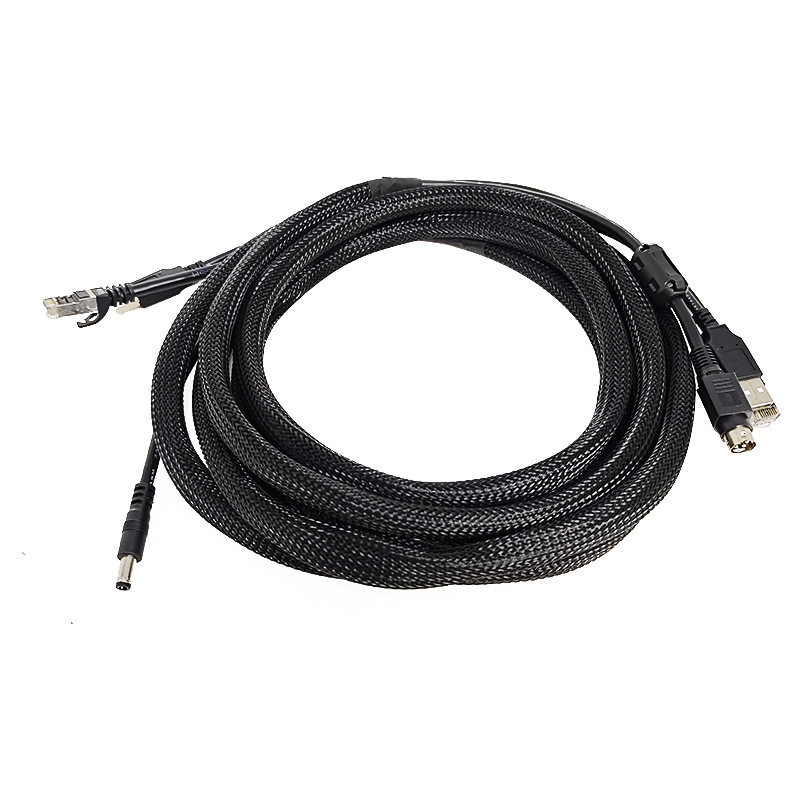
Industrial equipment connection cables are specialized connection cables designed for industrial automation, CNC machine tools, heavy machinery, and industrial control systems. They are the basic medium for power transmission and signal interaction between equipment, modules, controllers, and actuators, covering a full range of categories such as power connection cables, signal connection cables, bus connection cables, and shielded connection cables. They are widely used for docking core industrial control components such as PLCs, servo motors, sensors, frequency converters, and industrial gateways. They are the basic core accessories for the interconnection and intercommunication of industrial equipment electrical systems. Many practitioners tend to confuse it with civilian cables and industrial wiring harnesses, but there are essential differences between the three in terms of working condition adaptation, structural design, and performance standards, and they cannot be used interchangeably. Firstly, it differs from ordinary civilian cables. Civilian cables are mainly used for indoor static purposes and are suitable for home environments with room temperature, dust-free, and no vibration. The material is mostly ordinary PVC insulation, which has low mechanical strength and poor weather resistance. It only meets basic needs such as low-voltage lighting and home appliance power supply, and has no anti-interference, oil pollution resistance, bending resistance, strict flame retardant, and insulation redundancy design. The industrial equipment connecting line needs to adapt to the harsh working conditions such as oil pollution, dust, high and low temperature sudden changes, high frequency vibration, strong electromagnetic interference, etc. in the workshop for a long time. It uses special materials such as modified cross-linking, fluoroplastics, nitrile, etc., with multiple properties such as flame retardant, oil resistant, cold resistant, high temperature resistant, anti-aging, etc., and has sufficient electrical safety margin to support 24-hour continuous operation. Secondly, there is a core difference from industrial wiring harnesses. Industrial wiring harnesses are * * integrated assembly components * *, which are customized by integrating multiple cables, terminals, connectors, and protective materials, and are specialized modular accessories for equipment; The industrial equipment connection line is a standardized single cable with a simple structure and strong universality. It can be freely cut and flexibly docked to adapt to temporary equipment connections, module replacements, line expansion, external equipment extension and other scenarios. Its universality is much higher than customized wire harnesses. In terms of performance standards, industrial equipment connection wires strictly follow GB/T and IEC industrial electrical standards, with mandatory indicators for voltage resistance level, insulation impedance, bending life, and protection performance, which can resist industrial interference such as frequency converter harmonics and motor electromagnetic radiation; Civil cables only meet basic household safety standards and have no industrial anti-interference design. In terms of service life, civilian cables are only 3-5 years, while industrial cables can be used for 10-15 years under normal operation and maintenance, meeting the long-term service needs of industrial equipment. Overall, industrial equipment connection lines have the core advantages of universality, high weather resistance, and high stability, and are essential basic electrical components for industrial equipment debugging, assembly, operation, and renovation.
Inquiry
LATEST BLOGS
 What are the construction standards and common installation error rectification plans for industrial equipment connection line installation?
 Working principle, grounding process, and common failure issues rectification of industrial equipment shielding connection wires?
 What is automotive wiring harness and what are its core functions in the overall vehicle system?
 What are the core process standards and quality control points for crimping automotive wire harness terminals?
INQUIRY
RELATED PRODUCTS
 What are the construction standards and common installation error rectification plans for industrial equipment connection line installation?RCD has over a decade of experience in the assembly of cables and connectors required for outdoor harsh environment equipment.
 Working principle, grounding process, and common failure issues rectification of industrial equipment shielding connection wires?RCD has over a decade of experience in the assembly of cables and connectors required for outdoor harsh environment equipment.
 What is automotive wiring harness and what are its core functions in the overall vehicle system?RCD has over a decade of experience in the assembly of cables and connectors required for outdoor harsh environment equipment.